
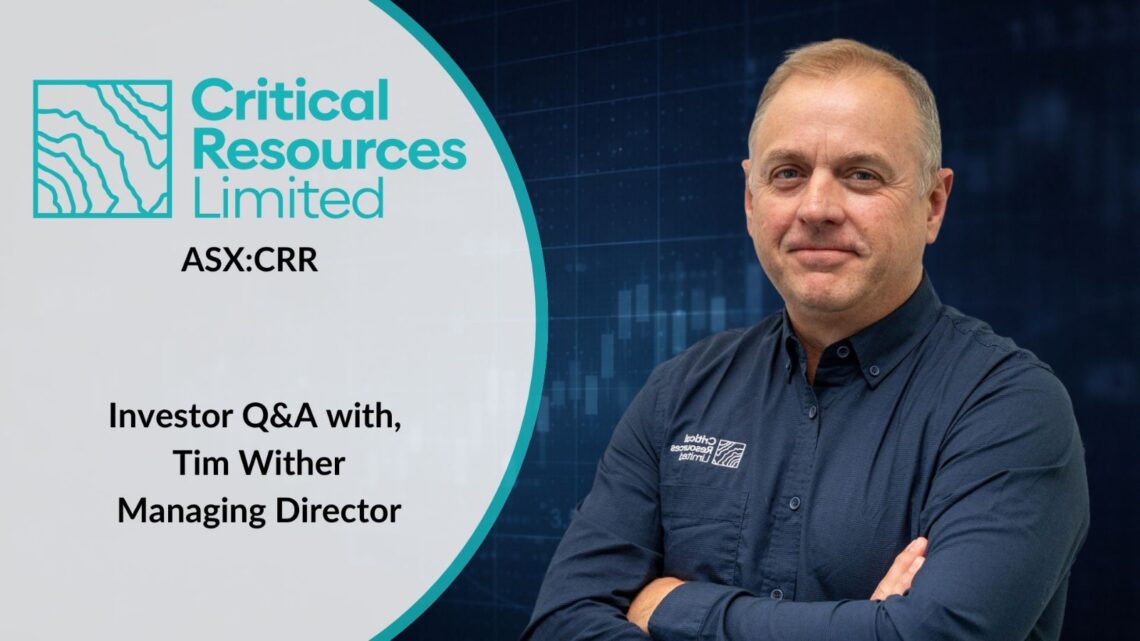
Critical Resources (ASX: CRR) commences field work across New Zealand gold and tungsten projects
April 1, 2026Critical Resources Managing Director Tim Wither spoke with MarketOpen to further discuss the commencement of field work at the Lammerlaw and Croesus projects following receipt of permit transfer approvals and regulatory consents. This Q&A focuses on the transition from desktop evaluation to active ground based exploration, the prioritisation of early stage programs across both assets, and the approach to validating historical gold, antimony and tungsten results. With field activities now underway at Lammerlaw and planned to follow at Croesus, the Company is progressing its New Zealand portfolio through staged programs aimed at confirming mineralisation, refining targets, and preparing for subsequent phases of work.
What operational change enabled immediate field work following permit transfer, and how is capital being prioritised across Lammerlaw and Croesus?
The key change was the receipt of Ministerial consent for permit transfer and approval for Minimum Impact Activities, which enabled us to commence field work. With these approvals in place, we were able to mobilise to site at Lammerlaw and initiate ground based exploration programs.
Our capital allocation is focused on first pass field work across both projects to establish a clearer understanding of the mineralised systems before progressing to more advanced stages. At Lammerlaw, current work includes mapping, rock and stream sampling across priority targets such as Devils Creek and Stony Creek. At Croesus, field work is planned to commence following completion of the Lammerlaw program, targeting both the gold antimony system and the greisen hosted tungsten system. This sequencing ensures capital is deployed in stages, aligned with the progression of each project.
What must current field work confirm at Croesus before it is considered a scalable gold antimony tungsten system?
At Croesus, the focus is on confirming the presence and extent of two mineral systems identified from historical work. The gold antimony system is defined by historical workings that produced more than 4,500 oz of gold at grades up to 17 g/t Au, and by legacy sampling that returned up to 28.9 g/t Au and 7.4% Sb across a corridor extending more than 5 km along strike.
For tungsten, historical sampling has returned grades of up to 42.6% WO3 from scheelite rich material, with additional float samples grading up to 26.6% WO3 and 19.9% WO3. The current field program is designed to map and sample these areas to confirm the extent of mineralisation and identify potential bedrock sources.
The objective is to validate these historical results through systematic field work and establish whether they represent continuous mineralised systems.
What near term indicators at Lammerlaw would validate the structural model and justify progression to drilling?
At Lammerlaw, the program is focused on confirming the structural interpretation across priority targets within the permit area. Field work is underway across the OPQ Trend at Devils Creek and the Stony Creek Trend, where historical sampling has returned gold values up to 2.72 g/t Au and tungsten anomalies up to 340 ppm W.
Validation will come from confirming the alignment between mapped structures, historical workings, and geochemical results through field mapping and sampling. This includes ground truthing of interpreted lode positions and assessing the relationship between structural features and mineralisation.
Establishing consistent geological and geochemical patterns across these targets will support the definition of priority zones and provide the basis for advancing to drill testing.
With no drilling completed and reliance on historical data, what key risks remain before committing further capital?
At this stage, no drilling has been completed by the Company, and current understanding is based on historical exploration and early stage field work. This means there is no direct confirmation of mineralisation continuity or geometry at depth.
The key risk is that historical results, including high grade samples and past production, may not translate into continuous or economically significant mineralised systems when assessed through systematic modern exploration.
There is also uncertainty around the relationship between mineralisation and structural controls, which is a focus of the current field programs. Until mapping and sampling confirm these relationships and define coherent targets, geological confidence remains early stage.
The current approach is to address these risks through staged field work before progressing to more capital intensive activities.
Execution now focused on systematic validation and target definition
Critical Resources near term focus is on completing first pass field programs at Lammerlaw and initiating work at Croesus, with initial geochemical results expected from Lammerlaw in May 2026 and results from Croesus anticipated in Q2 2026, subject to laboratory turnaround times. This phase is centred on integrating field data with historical information to refine priority targets and establish a clear exploration framework across both projects.
In parallel, work across the broader portfolio, including Cap Burn, continues to advance with soil geochemistry programs and planning underway for follow up RC drilling targeting structurally controlled mineralisation beneath the Cap Burn Fault. The sequencing of these activities reflects a staged approach to capital deployment, with each program designed to incrementally increase geological confidence and support the definition of drill ready targets across the Company’s New Zealand assets.
Please note the following valuable information before using this website.
Independent Research
Market Open Australia is intended to be used only for educational and informative purposes, and any information on this website should not be taken as investment advice or guidance. It is important to conduct your own research before making any investment decisions, which should be based on your own investment needs and personal circumstances. Any investment decisions based on information contained on this website should be taken in line with independent financial advice from a qualified professional or should be independently researched and verified.