
Critical Resources (ASX: CRR) advances solid state battery strategy with ASE validation
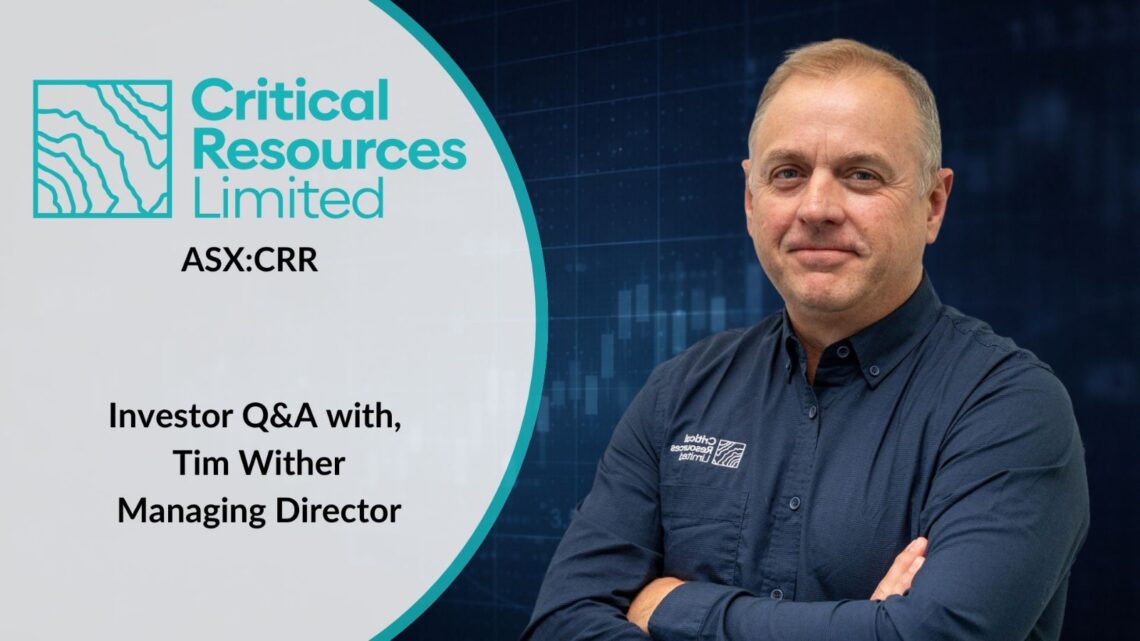
March 19, 2026Critical Resources Managing Director Tim Wither spoke with MarketOpen to answer key investor questions in relation to the Company’s Amorphous Solid State Electrolyte program and its role within a broader integrated battery strategy.
The discussion centred on what has changed following laboratory validation results, including sustained lithium metal interface stability for more than 1,200 hours, room temperature performance, and demonstrated operation within a full cell configuration.
The results shift the program beyond theoretical assessment and provide a more defined technical position at the materials stage, while maintaining a structured and capital disciplined evaluation pathway under the CEPS framework.
What has materially changed in technical confidence at this stage?
What has changed is that we have moved from theoretical assessment to demonstrated laboratory performance — confirmed ionic conductivity of 3.2 mS cm⁻¹ at room temperature, low activation energy of 0.27 eV, and sustained interface stability for more than 1,200 hours, all within a working full-cell architecture, not just isolated material testing.
That last point matters. Confirming the electrolyte can function inside a complete cell configuration — rather than only under component-level conditions — is a meaningful step. Post-cycling XRD and XPS analysis identified no new phase changes or new chemical species at either electrode interface, which is precisely what you want to see at this stage.
The outcome is that several of the most persistent early-stage failure modes have now been addressed under controlled laboratory conditions. That gives us a clearer, more technically grounded basis to advance into more representative cell-level evaluation.
With over 1,200 hours of interface stability demonstrated, which key risks have now been addressed and which remain?
Sustained stability for more than 1,200 hours at a current density of 0.1 mA cm⁻² addresses what has historically been one of the hardest problems in solid-state battery development — degradation and short-circuit risk at the lithium-metal interface. We’ve also confirmed room-temperature ionic conductivity and functional performance within a full-cell architecture, so the electrolyte is no longer theoretical.
What remains is extending that performance across a broader range of conditions, improving consistency across the operating range, and ultimately demonstrating performance under compression — both conventional uniaxial pressing and Warm Isostatic Pressing, which applies uniform omnidirectional pressure and is relevant to scalable manufacturing pathways. Those are the next gates in the program.
I want to be clear that this is still early-stage laboratory work. We are not claiming a commercial-ready battery — we are systematically eliminating the technical failure modes that have constrained the field, one at a time, under a disciplined evaluation framework.
How are the ASE and DSD programs being sequenced to ensure capital efficient progression from materials validation to cell level performance?
The two programs are designed as parallel but connected workstreams. ASE addresses materials performance — electrolyte stability, lithium-metal compatibility, ionic conductivity. DSD addresses manufacturing — specifically, solvent-free cathode fabrication that removes the process complexity and environmental burden of conventional slurry-based production.
Capital discipline means we validate each component independently before combining them. That way, if there’s a problem at the integration stage, we know what caused it. The next deliberate step is to commence controlled cathode-electrolyte interface trials using DSD-fabricated cathode architectures — connecting the two workstreams into a unified solid-state cell evaluation pathway.
The logic is that you don’t want to discover a materials failure and a manufacturing failure at the same time. Sequential validation, then integration.
What near term milestones will determine whether the program advances beyond early stage laboratory evaluation over the next 6 months?
There are five defined workstreams over the next six months. First, we continue refining electrolyte composition — targeting improved conductivity, interface stability, and consistency across a broader operating range. Second, we expand post-cycling XRD and XPS analysis to build the dataset needed to model interface behaviour over time.
Third, we assess cell performance under both uniaxial pressing and Warm Isostatic Pressing — understanding how compression affects interface contact and resistance, and what that means for eventual manufacturing pathways. Fourth, we progress toward more representative full-cell configurations integrating optimised electrolyte and cathode formulations — the critical bridge between materials validation and cell-level metrics.
And fifth, we commence DSD integration trials — connecting the two workstreams for the first time. That’s the milestone I’m most focused on, because it’s where materials performance and manufacturing approach meet in a single cell architecture.
Building toward integrated cell level performance
The program at Critical Resources is advancing in the right direction — from theoretical feasibility to laboratory-validated performance, with a defined pathway toward cell-level evaluation. The technical foundation is strengthening, and the integration of the ASE and DSD workstreams positions us to address both materials performance and manufacturing complexity within a single, capital-disciplined evaluation program.
Our focus remains on what solid-state batteries can do that conventional batteries cannot — reliable operation in environments where liquid electrolyte systems fail. That is the market we are building toward, and these results keep us on that path.
Please note the following valuable information before using this website.
Independent Research
Market Open Australia is intended to be used only for educational and informative purposes, and any information on this website should not be taken as investment advice or guidance. It is important to conduct your own research before making any investment decisions, which should be based on your own investment needs and personal circumstances. Any investment decisions based on information contained on this website should be taken in line with independent financial advice from a qualified professional or should be independently researched and verified.